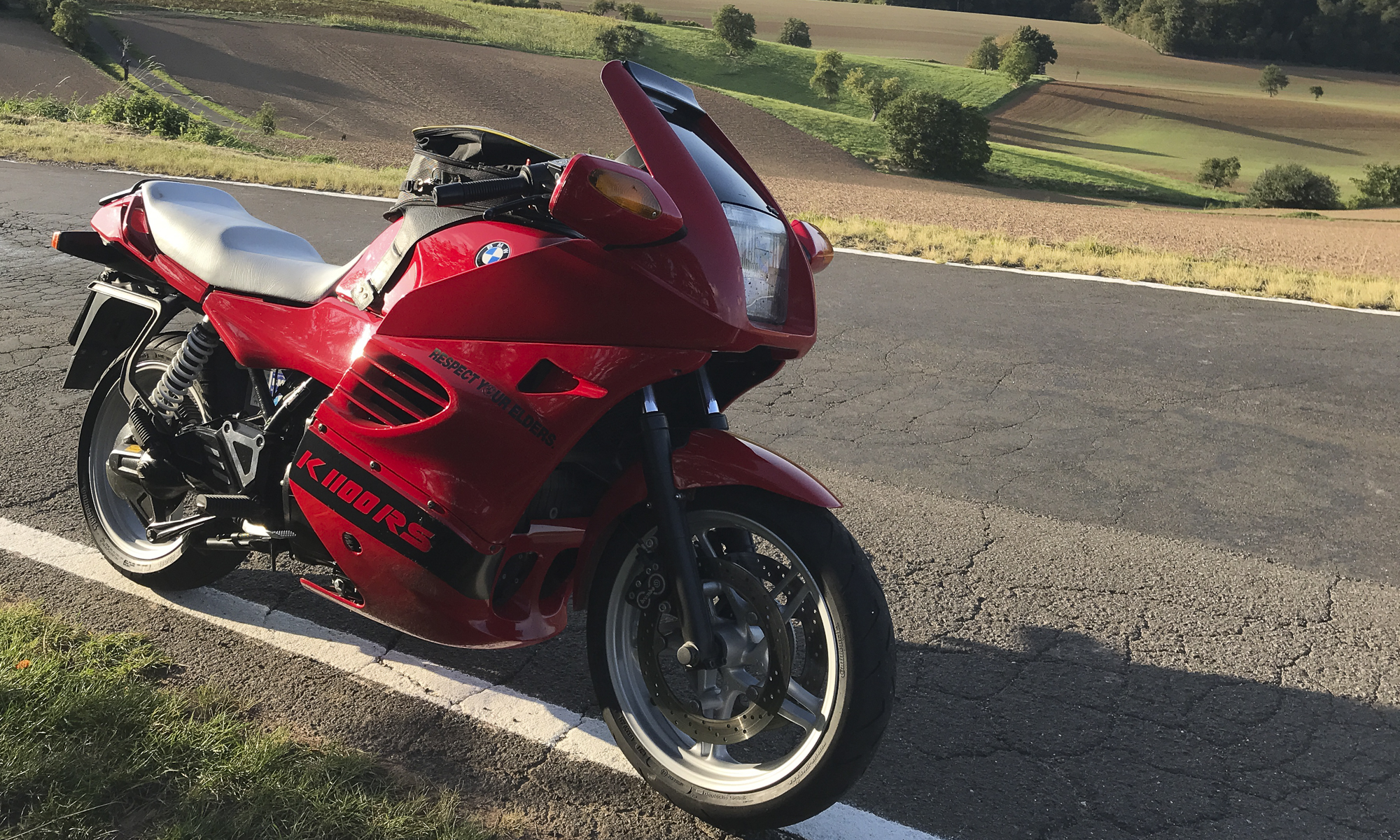
BMW K1100RS to K1200RS Wheel Conversion
Note: Any reference to the BMW K1100 or K1100RS motorcycles in this article can also be taken to include the K1, K100RS 16v and K1100LT models.
Preamble
Changing the wheels of your BMW K1100RS is probably one of the first restomod/upgrade jobs to tackle. Why? The original three-spoke wheels look clunky and out-dated and you’ll be looking to move to a wheel/tyre package based upon conventional 17″ wheel sizes. We’ll be running the same 120/70 x 17 tyre at the front but exchanging the old 160/60 x 18 for either a 170/60 x 17 (fitted to a 5″ rim) or a 180/55 x 17 (fitted to a 5.5″ rim). I’ve tried both rear options. Honestly, the 170 rides really well, remains neutral with less steering force and is closest to the original wheel’s circumference. But the 180 offers the most tyre options and simply looks better. However, as that fat 180 wears down, the steering will get heavier and more sensitive to road camber changes. Modern litre-bikes have slightly wider handlebars – probably to give the rider more leverage. Changing the handlebars will be a future upgrade.
Use the wheels from the K1200RS and GT models
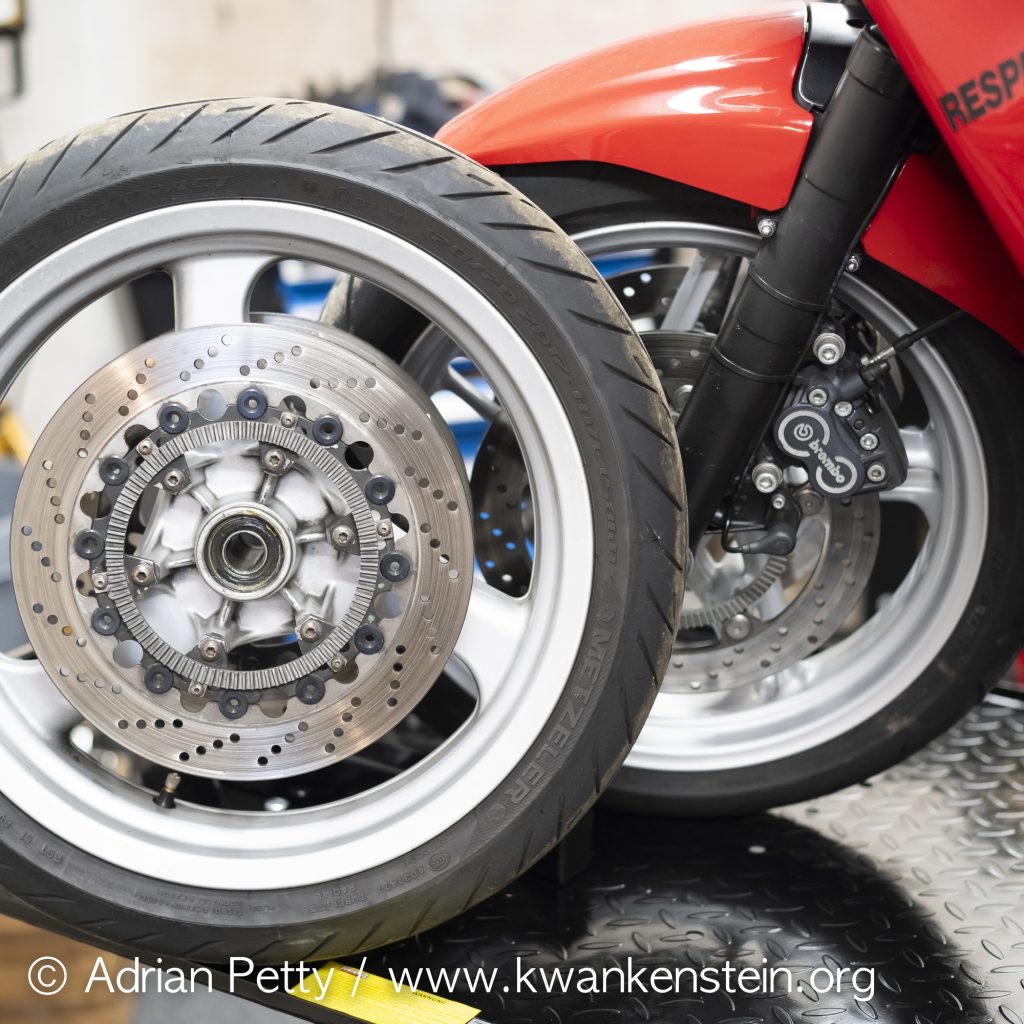
I recommend that you start by sourcing a front wheel from an earlier 1996-2001 BMW K1200RS (K589) model which was fitted with BMW’s ABS II system. The (K589) front wheel ABS-sensor-ring is constructed as a metal casting – as opposed to the pressed steel construction used on the later (K41) models – and this is closest to the original K1100RS ABS setup. It‘s what I installed. Whichever wheel, we need the earlier (K589) brake rotors as they have the correct diameter (i.e. 305mm) for the K1100 brake caliper. If you don’t have ABS on your K1100 then you will need to additionally fit spacers on the ABS-sensor side of the wheel – but we’ll cover this. I would suggest to save time and money by buying a wheel that is complete with brake discs and ABS-sensor-ring. Since the front wheel bearings will be exchanged through this conversion, it would be an ideal opportunity to send your wheels off for powder-coating. I wish I had done that. The resulting finish is durable, smooth and easy to clean. But the standard matt-silver also looks great on most bikes.
The rear wheel can be taken from any BMW K1200RS or BMW K1200GT (K41) model. Choose your wheel size according to the tyre you’ll be running – a 5″ rim for a 170/60 tyre or a 5.5″ rim for a 180/55 tyre. I’ve already mentioned that the 180 needs a bit more effort to muscle around – so your choice.
| Axle | Tyre | Donor K1200RS (K589) | Donor K1200RS/GT (K41) |
| Front | 120/70 x 17 | 3.5 x 17 MT Requires the 5mm, cast, ABS ring. | 3.5 x 17 MT Requires the thinner, pressed steel, ABS ring. |
| Rear | 170/60 x 17 | 5 x 17 MT | Not applicable |
| Optional Rear | 180/55 x 17 | 5.5 x 17 MT | 5.5 x 17 MT |
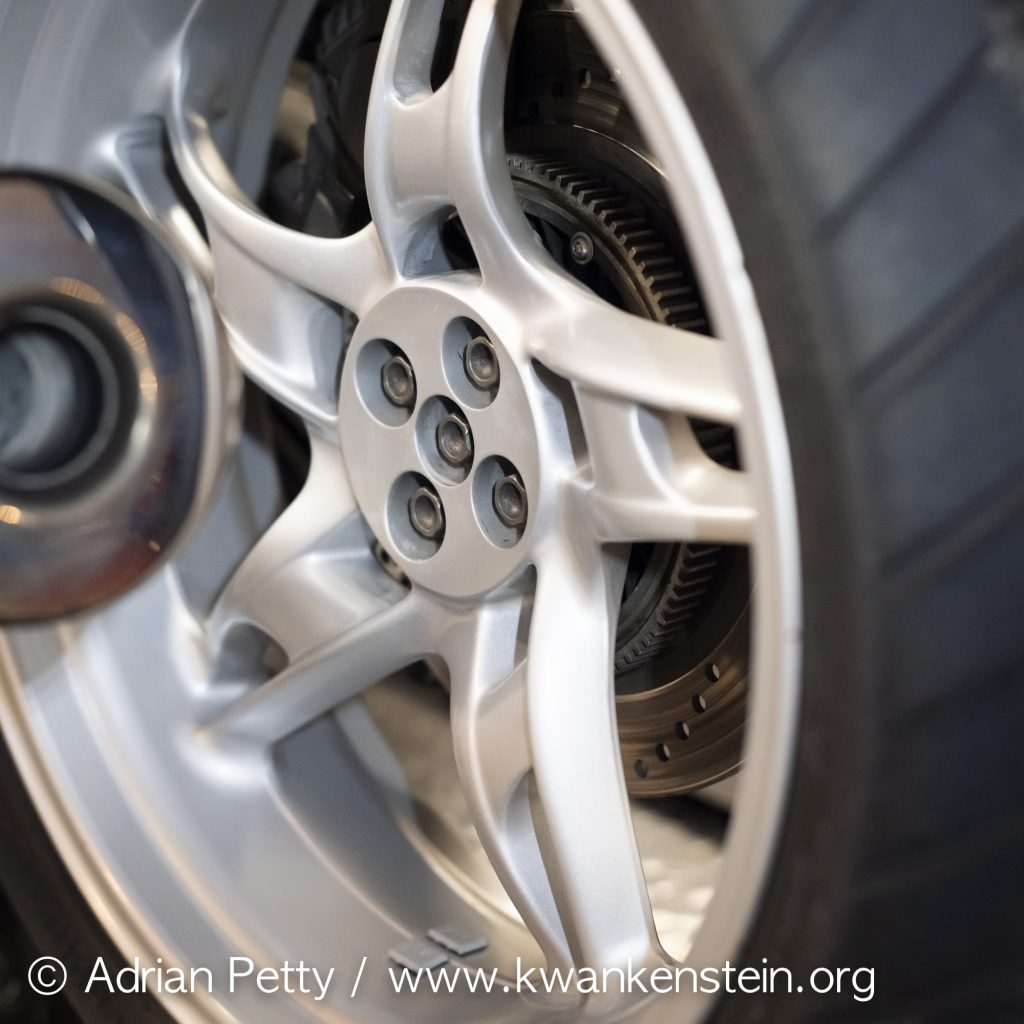
Fitting the K1200RS Rear Wheel
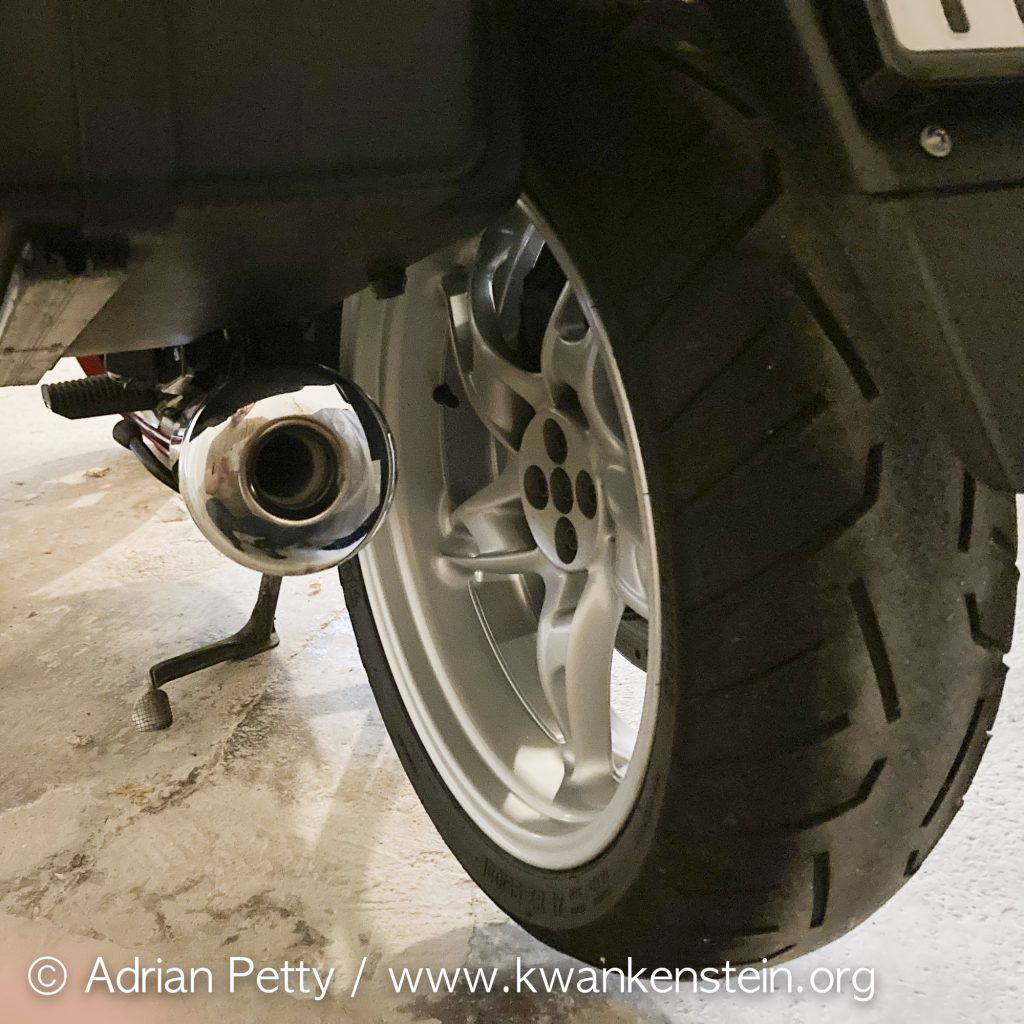
The rear wheel is just about “plug and play” – except that you will need first to remove the exhaust system of your K1100RS to gain sufficient clearance to mount up the new wheel. Otherwise, for the 5.5″ wheel, the M5 bolts that attach the ABS ring to the brake hub will need to be exchanged for a flatter-style bolt. It is essential that you use the standard K1200RS wheel mounting hardware and 2mm spacer. The K1100RS wheel bolts are 60mm long and – due to the different dimensions of the K1200 wheel’s mounting flange – they could feel tightly done up but possibly still come into contact with the mounting hub, resulting in the wheel actually being loose! So please, use the K1200 wheel mounting bolts (55mm) and the standard K1200 2mm spacer. On my machine, this resulted in a 4-5mm gap between the Continental Road Attack 180/55 tyre and the swinging arm – which is sufficient to allow for tyre expansion in use.
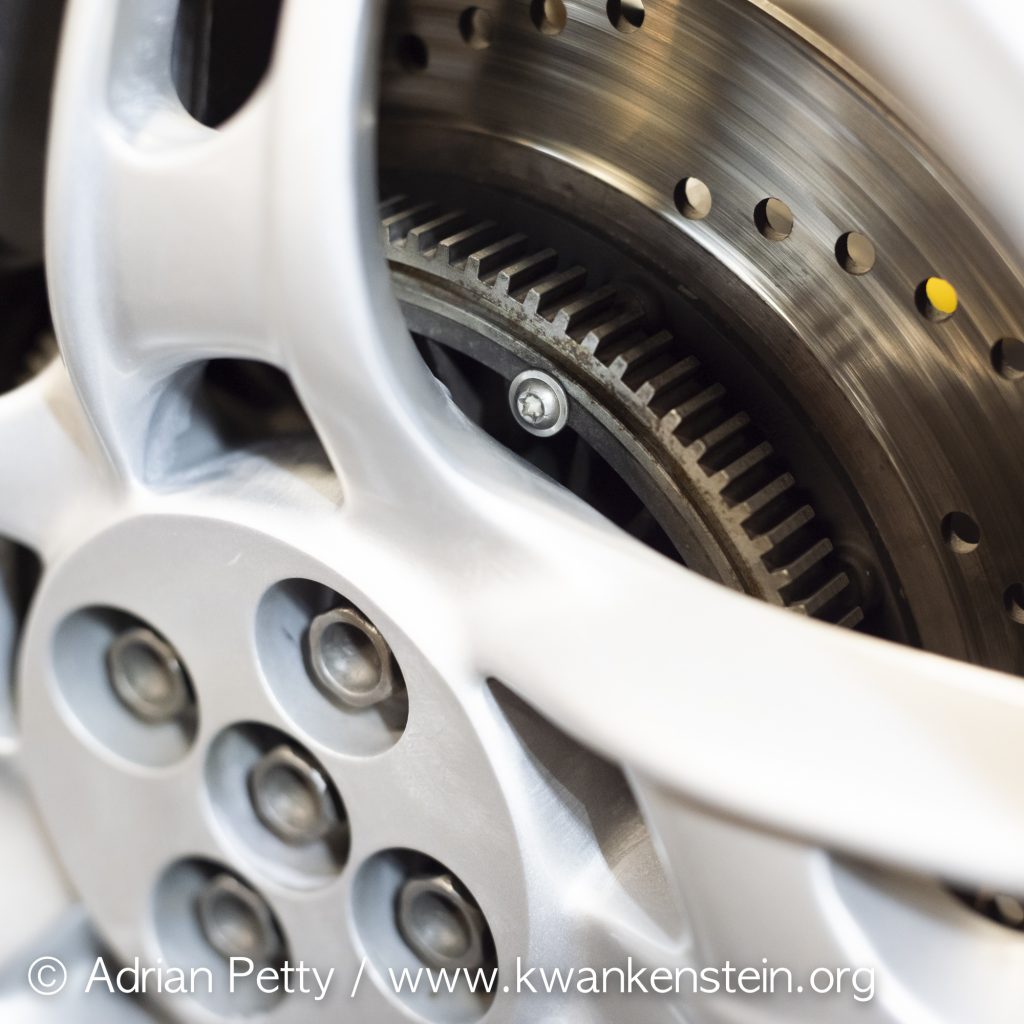
Rear Wheel Fitting Summary
- The K1100 exhaust system needs to be removed for clearance.
- Use the five original BMW K1200RS/GT wheel mounting bolts and 2mm spacer.
- Exchange the mounting bolts of the ABS sensor ring for flatter items to avoid contact with the 5.5″ wheel.
- Torque the wheel bolts cross-wise to an initial 50Nm and then, in a second step, to 105Nm.
- Check for tightness after 100km.
Converting the K1200RS Front Wheel
If the rear wheel conversion was more-or-less “plug and play” then the front wheel offers considerably more challenges due to the difference in axle size between the K1100RS with a conventional fork (25mm axle) and the K1200RS fitted with a Telelever front-end (20mm axle).
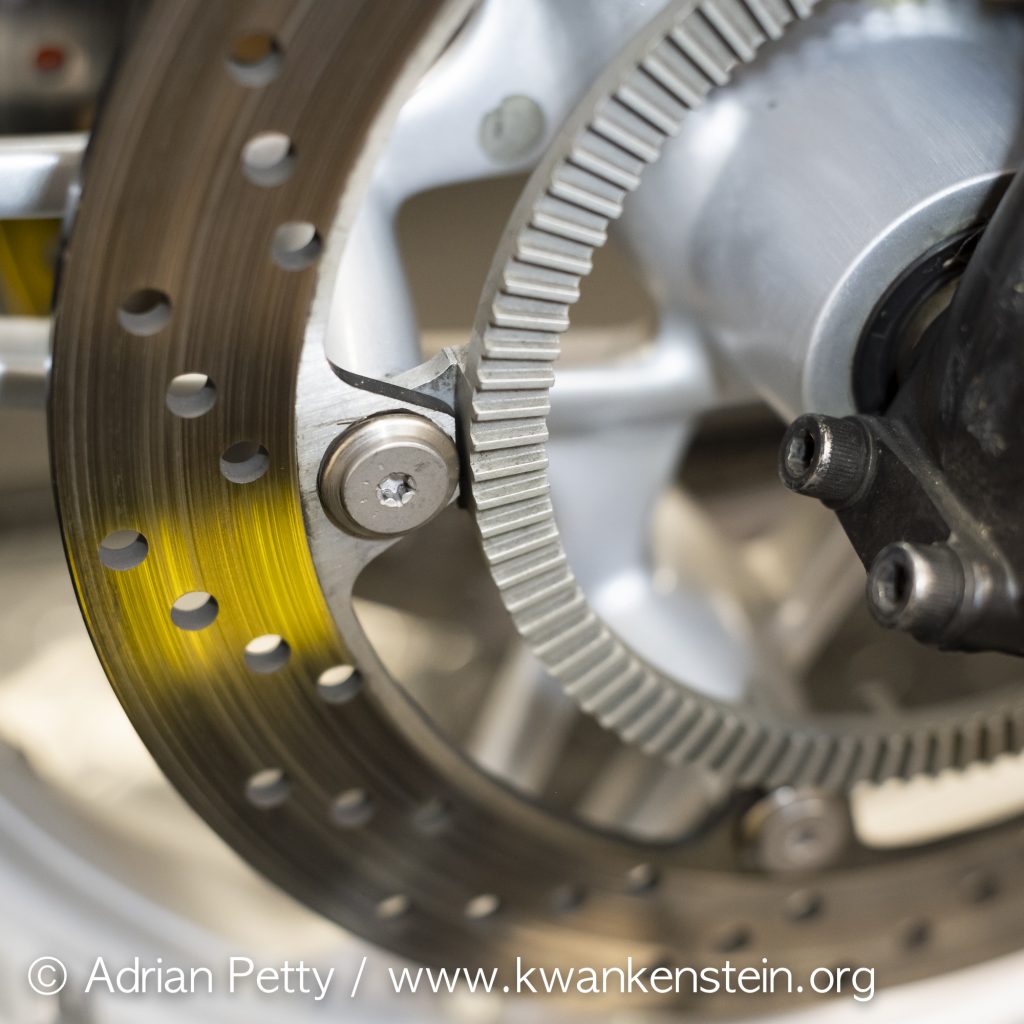
It took quite a bit of online research to find a solution that overcomes the different axle dimensions, but I eventually adopted the hardware recommendations and method invented by the author of an extremely useful German-language website – www.k1100rr.de. Other solutions out there involve creating an entirely new axle – which is very time and cost intensive. Consider also that the conventional forks of this machine were originally engineered with a 25mm axle to achieve the necessary strength and torsional stiffness. So this conversion method – as originally documented by www.k1100rr.de – is the technically simpler solution that retains the key component of the original K1100RS axle design – namely the correctly dimensioned, 25mm axle.
First up, you’ll need to do some online shopping to obtain the following parts:
| Item | Size | Part No | Qty |
| Left-hand wheel bearing | 25x47x12 | 6005 2RS | 1 |
| Right-hand wheel bearing | 25x47x12 | 6005 2RS | 1 |
| 25x47x8 | 16005 2RS | 1 | |
| Bearing seals | 30x47x7 | 1 | |
| 32x47x7 | 1 | ||
| Internal bearing spacer (K1100RS) | 36311458419 | 1 | |
| Brake disc mounting bolt | M8x27 | 34117700989 | 10 |
Compared to the standard front wheel of the K1100RS, the width of the combined right-hand wheel bearing assembly becomes 12+8=20mm (originally 20.6mm) meaning that we have a difference of 0.6mm. Please just get out a ruler right now and observe what roughly half a millimetre looks like. Then consider this difference compared to the 160mm fork travel of your K1100. Yes, it’s not perfect, but shall we proceed?
The first task is to unbolt all the hardware items of your donor wheel – namely the brake discs and ABS-sensor-ring – and place them to one side. I suggest to photograph the items as they are removed for future reference. Then you will need to remove the K1200RS wheel bearings from the wheel. I’m not going to document how I did that. In the end, my Buddy came over and knocked them out for me. I would suggest to invest in some good quality tools for the purpose. Next, install one of the “6005 2RS” bearings on the left-hand side of the wheel. You will feel/hear when it is correctly seated. Note that I always refer to left and right from the perspective of the rider. Next, insert the K1100RS internal bearing spacer followed by the second “6005 2RS” wheel bearing. Then install the “16005 2RS” bearing – which is the smaller 8mm wide item. However, I don’t insist upon the installation order of the bearings. Just promise not to bang them in crudely and insensitively. Tip: Put the bearings in the freezer overnight to gain a little bit of additional clearance. Then gently install the bearing seals – applying some good quality grease.
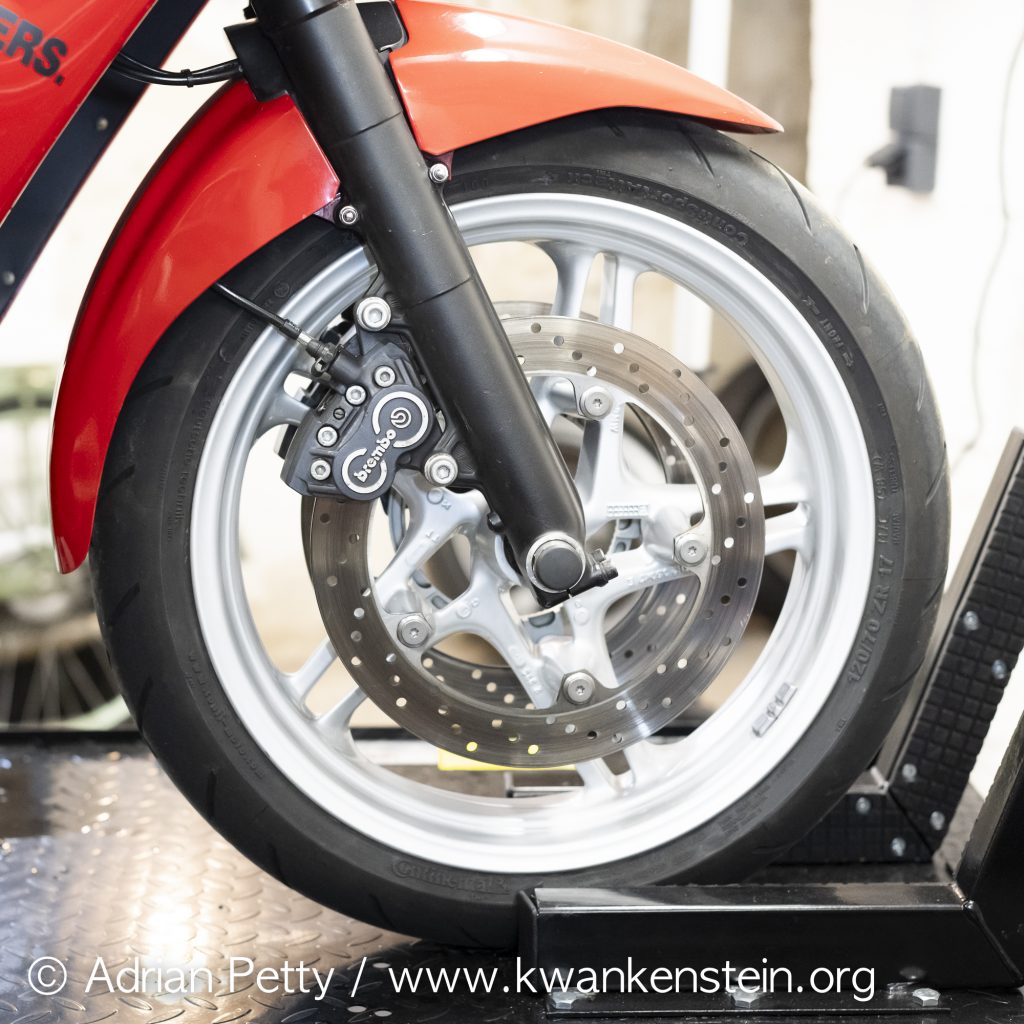
We’ve now done all of the work on the axle. Let’s continue with the brakes. The K1200RS brake discs we are using are 305mm in diameter – nominally the same as the K1100RS – except that the bolt pattern is different (i.e. larger). This means that the standard K1200RS round-head brake disc bolts will have contact with the lower fork stanchion – which was flattened in that area by design for the original bolt pattern. The author of www.k1100rr.de describes a method where both fork stanchions are modified such that this flattened surface on the inside is extended upwards sufficiently to clear the larger rotating circle of the K1200RS disc mounting bolts. However, the needed clearance can be acquired in an easier way! Simply order 10 original BMW brake disc mounting bolts (part number in shopping list above) which have a flat-head construction. These are used on a multitude of BMW motorcycles manufactured from 2007 onwards and have the correct material strength. The flat-head bolt clears the fork stanchions without any further modification. Except: you will need to finesse the inside diameter of the brake disc mounting collets by drilling them out very slightly (Note to the author to insert the drill bit size that was used). Now bolt the brake discs back onto the wheel using the new flat-head bolts. Be sure to return the thin steel spring washers to their original position. The new bolts are already prepped with Loctite (or similar) so you’re good to go. Don’t forget the ABS-sensor-ring on the left side – it bolts between the wheel and the brake disc. But you know that because you took pictures for reference during disassembly, right?
Fitting the K1200RS Front Wheel
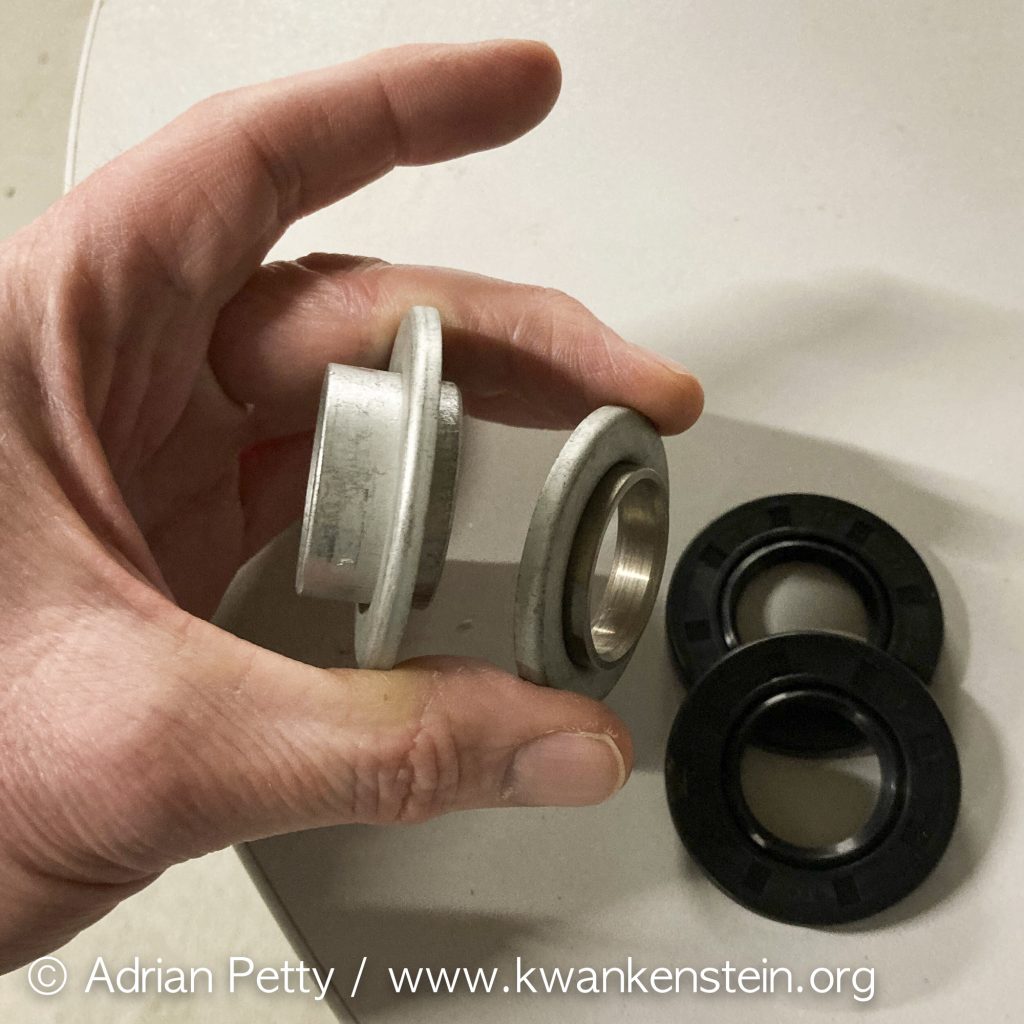
Take the two existing K1100RS axle spacers – as shown in the photo below. They both have a collet – like a washer that is simply an interference fit. We don’t need these collets anymore to protect the wheel bearings from road grit as we’re now using rubber bearing seals. Gently remove the collets – note that very little force is required. I used a combination of a large 1/2″ socket, some WD40 for lubrication and a vice to literally slide them off. You’ll be left with the two short tubes – the axle spacers – which are then ready to work with the new rubber bearing seals.
I normally have the motorcycle on the centre stand with the front supported under the engine with a scissor jack – which helps to fine tune the height of the fork to align with the wheel for installation of the axle. Clean and grease the axle and proceed to gently insert it from the right – using the correct spacer at each side – to secure the new wheel to the forks of your K1100RS. Your hands will be trembling with excitement at this point. Stay calm – there are still a few things to take care of. At first, just turn the axle retaining bolt and the fork stanchion clamp bolts to barely more than hand tight. Because: you’re going to remove the scissor jack (or your preferred supporting method) from under the engine and finally lower the front end of the bike to the ground. Before doing so, please rotate the wheel and check the clearances and freedom of movement. With the bike now back on the ground and the axle bolts hand tight, take the bike off the stand, sit on it and use some rocking force to compress the forks over a number of cycles. There should be completely smooth and free movement of the forks – just like before. Now tighten the axle fasteners to BMW’s specifications – starting with the axle retaining bolt on the left end of the axle. Check again for free movement of the forks. As a final step, check the clearance between the ABS sensor and the ABS-sensor-ring and make sure that you’re within BMW’s specifications – otherwise your ABS system may throw an error which will disable the function of your bike’s ABS until it is corrected.
Congratulations! The first and probably most important modification of the beloved BMW K1100RS is now complete. Please let me know how this method worked out for you. If there are any omissions or additional clarifications needed, I’m more than happy to incorporate them in this article.
Don’t forget to check the tightness of all the fasteners you touched after 100km at the latest. Ride safely!